Showing posts with label drake passage. Show all posts

Sunday, April 5, 2020

NBP to Punta Arenas

On Tuesday 3/24, the RVIB Nathaniel B Palmer arrived to Palmer Station. Well, as close as it could safely get!


In a few chaotic hours, we used a station zodiac to get all the cargo we needed to get on board, say way too many goodbyes, and move the 11 of us who were leaving station on board. Shockingly quickly, I was seeing Palmer from afar...


...and then not at all, as we began the long sail north. It was beautiful, as always, being out on the water as we began motoring up the peninsula.


The NBP is big enough that no one ever has to sleep in containers in the hold, thank goodness. I shared this super-cozy room with one of the scientists leaving Palmer. (Hilariously, that TV has cassette tape and VHS players.)


And about 24 hours after our departure from Palmer, the seas suddenly started feeling rough and we made our way across the Drake in moderate seas.


I was taking anti-seasickness meds the whole time and so was feeling super sleepy and woozy and the  hours and even the days totally melted together.

On Saturday we made it to Punta Arenas, Chile, but because Chile's borders have been closed to international travelers, we were not allowed to leave the boat. For three more days we stayed on board, doing what we could to offload what could be offloaded without us leaving the vessel, reading, playing games, watching movies, and taking advantage of kind efforts of people on board to entertain us, such as one of the engineers giving a tour of the engine rooms:


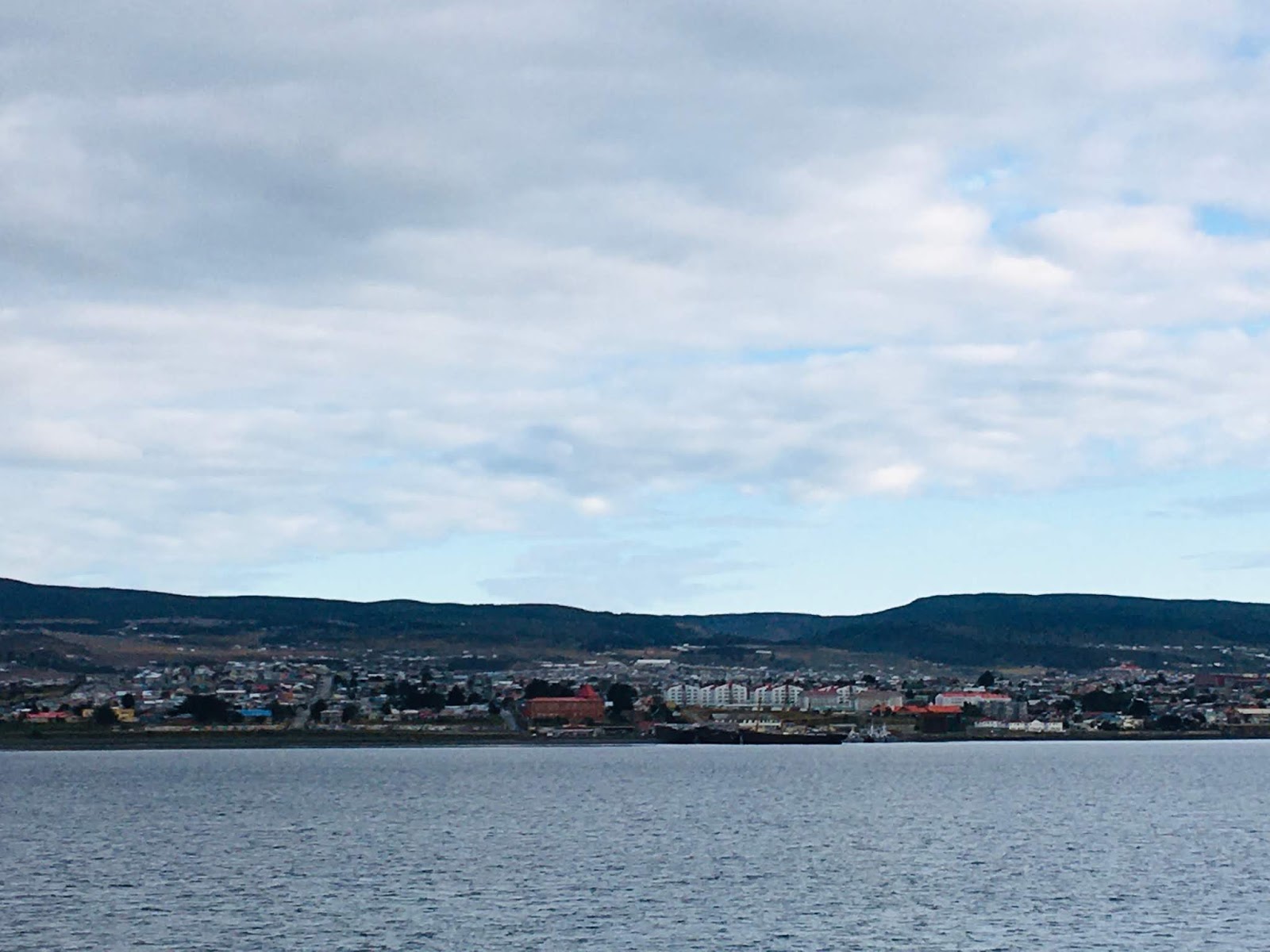
...gazing at Punta Arenas in the beautiful weather and wishing we could go for walks through town...

...said a distant hello to the LMG, docked on the opposite side of the pier, from which position the hazardous waste containers on board were moved over to the NBP for eventual travel north...


...and went to several science talks. It was really wonderful to get to interact with the scientists who had been at sea for a couple of months researching the Thwaites Glacier (the fastest-melting area of Antarctica) and to hear presentations on their projects.


As the days passed, I found myself spending more and more time walking tiny circles around the 01 deck of the NBP just to get some fresh air and movement. (The boat has a gym but the treadmill was broken.) One evening I was out there with this ailing bee, which I felt sorry to see suffering, but which was also a notable sight for me after half a year too far south to see any insect this size.


Our last evening on the boat was absolutely gorgeous, making me ache to be able to step off the boat and start the month of exploring Chile I'd been planning as a post-contract adventure.


But of course...that is not possible with what is happening in the world right now, and the disappointment of that lost travel adventure is more than balanced with my gratitude that I was able to be heading home to a family that is still safe and healthy and has everything it needs right now.

Saturday, October 19, 2019

Straits of Magellan and the Drake Passage

There are certain places on this planet that, as my younger self read and learned about the world from books, sounded just unbelievably exotic to me and are now a particular thrill to experience in person. I felt like that when I went to Borneo last year, and I felt that way again as the LMG began its pass through the Straits of Magellan and passed Cape Horn. I mean, come on: the freaking STRAITS OF MAGELLAN! This is some legendary age-of-exploration stuff here. And I was there! As the radar of the ship's location showed (the southern tip of South America on the left and Isla de los Estados on the right)...


...and then I went up on deck to experience first hand. That's the sun setting over Cape Horn behind me...


...and Isla de los Estados glowing in that setting sun on the other side of the ship.


Total peace and beauty.


I'm glad I appreciated it for everything it was worth, because already the waters were getting rockier, and the next couple days were something else. I was on so many sea-sickness meds and was so out of it from that and the constant movement that honestly the whole thing was a total blur. But here's a little bit of what it was like to go through the Drake.


At one point I walked into the galley as one of the first really big swells tossed us, and several bowls of fruit that had been on shelves above the tables all went soaring across the room and the fruit landed and started rolling everywhere. One of the ship's crew came in right behind me and I regret not having stopped to take a video of us trying to pick up all the fruit. Every time we would reach out for an apple or orange, the ship would roll and it would dart away from our hands. It took forever to clean up. I can tell you definitively, though, that prescription anti-nausea meds for sea-sickness (despite giving you terrible dry mouth and dilating your eyes so you can't see anything up close and making you too tired to focus on much of anything) WORK, even if they make you feel like a zombie.

The upper decks of the ship were closed while we were rocking and rolling through the worst of it--too much danger of someone getting tossed overboard, which would have been a death sentence. We did manage, though, to complete a Drake Passage survey--one of the science projects that happens on the LMG: every hour or so, we released sensors into the water that recorded temperature as they sank, plus we did water samples several times/day. There were multiple shifts of volunteers, so I signed up to help with that and am glad I did. That was a good excuse to get a couple breaths of fresh air and a legit reason for being briefly on deck as we held on tight for science!


Other than that, I just slept as much as I could through the worst of the Drake, which was certainly not even as bad as it could have been! I wish I had more pictures of it, but I was too out of it to be able to think about how to record the experience.

Sunday, October 13, 2019

South from Chile

Holy moly, the past two weeks have been quite a ride. There is so much to catch you up on. I will just start to do that little by little, post by post. I am all settled into Palmer Station now, but when last we spoke I was just leaving Punta Arenas, Chile. So let's back up and take a step toward getting you caught up....

For our last night in Punta Arenas, we slept aboard the LMG. (Oh, and a correction from the last post: I've since learned that the US Antarctic program does not actually own the two icebreakers it operates on the peninsula--just leases them.) This was handy for me since I am working in Cargo at Palmer this season. At McMurdo and South Pole cargo is transported mostly by plane, but Palmer is a marine station, so I began my ongoing crash-course in marine cargo operations. At first this just consisted of observing the movement of a RHIB that had been transported north for the winter back onto the ship for its return to Palmer for the summer.


Speaking of my job...I was hired in August by the Peninsula Logistics Coordinator (a full-time position with the program) as Palmer's Cargoperson for the summer, to be working under an on-site Cargo Senior. A couple of weeks after I signed the Cargoperson contract, I heard through the grapevine that the woman who hired me had quit the program. So--I was assured by the station manager when I reached out--things were going to be a little chaotic but manageable. Then, as we were starting the flights south to Punta Arenas, the guy who was supposed to be Cargo Senior apparently decided he was too overwhelmed by the chaos side of things and he decided at the last minute not to get on the plane. Long story short, the station manager ended up convincing me that under the circumstances, the best option would be for me to step into the Cargo Senior role, be able to complete turn-over with the winter Cargo Senior to start learning the job, the winter Cargoperson would stay an extra few weeks, and the program would fast-track the hiring of a summer Cargoperson to take over the job I was supposed to do. So I got on the boat with a 3-inch stack of operating documents to read to learn about the much more desk-, paperwork-, and computer-system-heavy job I am now going to be doing. Eek!

But I wasn't about to bail as well, so when the time came, on a day too windy for the LMG to leave the pier unassisted, a tugboat came along to drag us out to sea...


...we watched Punta Arenas fade off into the distance...


...we did a life boat drill in case of having to evacuate the ship (and by the way, for those of you who know him, doesn't the guy second from right look EXACTLY like my brother, in this picture?)...


...and off we sailed into the Southern Ocean.


Well, to be more accurate, we weren't in the open ocean to start with. The trip from Punta Arenas to Palmer Station generally takes four days: one day navigating the straights and islands of Tierra del Fuego; two days for the crossing of the mighty Drake Passage, aka the "Roaring Forties" and the "Furious Fifties" (those numbers referring to latitude) between South America and Antarctica, famously the most consistently tumultuous seas on the planet; and the fourth day on calmer waters again, navigating the rest of the way south along the Antarctic Peninsula.

While we were protected from the open ocean those first 30 or so along Tierra del Fuego, we were lucky to see a whole bunch of Commerson's dolphins!


But we knew the calm waters wouldn't last, as the weather forecast did not look fantastic. While we could, we visited the outside decks of the LMG, appreciating the epic sunsets.


That's probably enough for now...
Next post I'll talk about the ship itself before it makes its voyage across the Drake!