There's an island very close to station that has long been an Adelie penguin nesting colony. Torgeson has seen a 90% decline of nesting Adelie pairs in recent years as a result of climate change (the Adelies are moving farther south and traditionally more northern species such as Gentoos and Chinstraps are more and more often seen around these parts). But I had nothing to compare it to so it was thrilling--now that the chicks are big enough that our visit won't stress or threaten them--to get to visit Torgie for the first time last week.
A lot of the chicks were almost as big as the adults at this point, but most of them had not molted so still looked like cute fluffy little kids.
The scenery on the island--including some dramatic metamorphic rocks--was also a joy to explore.
Thanks to CL for taking these pics as penguins got thrillingly close to me. The Antarctic Treaty has strict rules about how close we are allowed to get to various kinds of wildlife without a scientific permit, and even if we are the regulated distance away and the animals are showing signs of distress, we are to move away to a greater distance. But if we are stationary and an animal approaches, that is the animal's choice. That happened a couple of times while I was at Torgie, once while I was just sitting and watching a colony (there was some cross-traffic!)...
...and again when I was back down at the shore getting ready to get back in the boat. I was ahead of the rest of the group and just sitting there quietly and these Adelies just popped out of the water directly in front of me. I didn't move at all, and they were so busy drying off and trying to figure out where to go next considering the other humans that were slowly making their way down from the top of the hill, I'm not even sure they noticed me!
Thursday, January 30, 2020
Monday, January 27, 2020
Animal visits
The amazing animal visits continue.
Chinstrap penguins are less common around here than Adelies (on the decline as global temps warm) or Gentoos (coming further south into our area much more commonly than they used to now that everything is warmer) so it's pretty exciting when one hops up on the rocks at station.
We've also seen crabeater seals stopping by for a visit near the pier:
And this AMAZINGLY huge leopard seal that spent a whole afternoon resting on a bergy bit that was floating right near station.
You can't see it too well, because silly me I don't have a camera other than my iPhone, but there's a Weddell seal in the lower half of this picture, in the snow that is pointing to the right, just lazing about on a Sunday morning.
Friday, January 24, 2020
Latest of Palmer gorgeousness
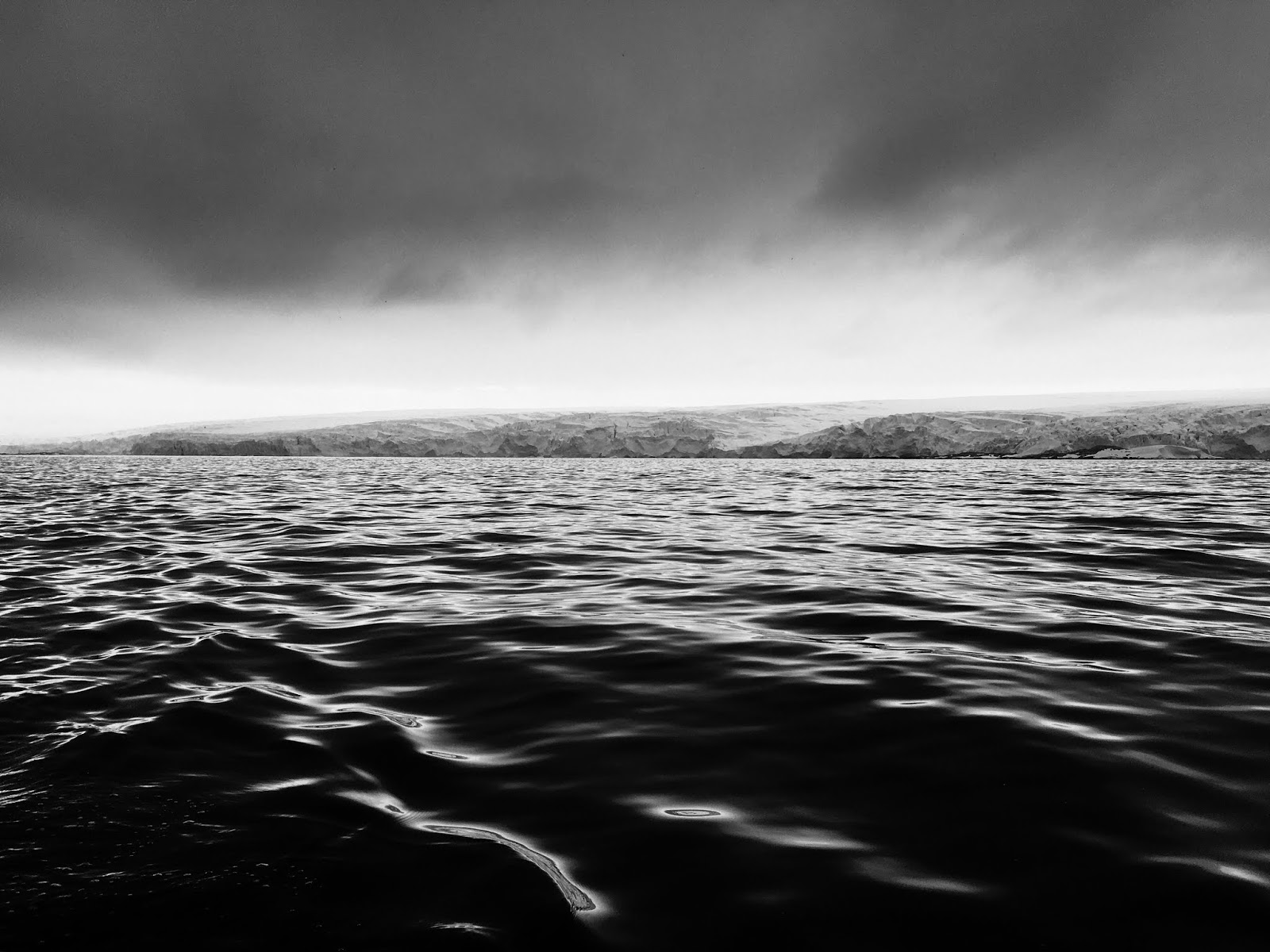
I'll just keep passing along these shots that don't necessarily have a story or theme, other than that it is so gorgeous here!
Skuas scanning the vista for potential food:
Neighborhood berg:
The day was bright and sunny:
The day was overcast and atmospheric:
Humpback waving hello:
Some bergs like to visit station:
Antarctic Eden (mosses of summertime on Bonaparte Point!):
Tuesday, January 21, 2020
Science!
Okay, it is WAY past due for me to talk about the REASON I am getting paid to be here and to do and see all of these amazing things: Science! I have been waiting until I have better pictures for this post, but it's not really happening that way, so I'm just going to go for it.
The United States Antarctic Program has an annual budget of about 450 million USD, 3-4 million of which is designated for Palmer Station (difficult to tease out Palmer's budget from that of the Lawrence M Gould and Nathaniel B Palmer research vessel budgets), and all of which is funding secured from the federal government by the National Science foundation to ultimately support research in one of three areas:
1) Understanding the Antarctic continent
2) Antarctica's role in global systems
3) Antarctica as a platform for science
The third of those areas encompasses much of the research that was going on at South Pole...all those telescopes, which weren't studying Antarctica at all, but that South Pole provided the perfect setting (high, dry, minimal light pollution).
The science going on at Palmer is much more focused on the first two areas of research--particularly marine biology/oceanography. There are research groups here conducting long-term studies of whales, birds, krill, bacteria, and other creatures they've been tracking for decades and have already been able to observe reacting to the planet's changing climate. In one of the experiments happening on station right now, a group is simulating future climate change in our aquarium to see how various Antarctic species will react in the future.
In general, the scientists here spend a lot of time on the water in Solas, Zodiac, or RHIB boats: going to nearby sites to count penguins or other birds; doing ocean transects; biopsying whales; collecting samples of small oceanic flora and fauna, and so on.
Often they bring back samples to the station aquarium for study or experimentation. Pictured here, Antarctic krill (essential food for penguins and whales)...
And all kinds of sea flora.
The United States Antarctic Program has an annual budget of about 450 million USD, 3-4 million of which is designated for Palmer Station (difficult to tease out Palmer's budget from that of the Lawrence M Gould and Nathaniel B Palmer research vessel budgets), and all of which is funding secured from the federal government by the National Science foundation to ultimately support research in one of three areas:
1) Understanding the Antarctic continent
2) Antarctica's role in global systems
3) Antarctica as a platform for science
The third of those areas encompasses much of the research that was going on at South Pole...all those telescopes, which weren't studying Antarctica at all, but that South Pole provided the perfect setting (high, dry, minimal light pollution).
The science going on at Palmer is much more focused on the first two areas of research--particularly marine biology/oceanography. There are research groups here conducting long-term studies of whales, birds, krill, bacteria, and other creatures they've been tracking for decades and have already been able to observe reacting to the planet's changing climate. In one of the experiments happening on station right now, a group is simulating future climate change in our aquarium to see how various Antarctic species will react in the future.
In general, the scientists here spend a lot of time on the water in Solas, Zodiac, or RHIB boats: going to nearby sites to count penguins or other birds; doing ocean transects; biopsying whales; collecting samples of small oceanic flora and fauna, and so on.
Often they bring back samples to the station aquarium for study or experimentation. Pictured here, Antarctic krill (essential food for penguins and whales)...
And all kinds of sea flora.
We have a team of divers on station right now, too. Of course they have INTENSELY insulated suits to protect them, but still: going out for 15-30 minute dives in Antarctic waters is pretty bad-ass.
And most weeks we have a science lecture given by one of the resident grantees (who are always coming and going, so there's always fresh blood and new projects happening) to educate us about the really cool things they are doing and studying down here. It's fun to learn about it, to interact with the scientists daily, and to be a tiny part of the enormous machinery of human kind seeking to better understand our planet, how we're impacting it, and the future consequences of our humanity on the rest of the species on Earth.
Saturday, January 18, 2020
Lemaire Channel and Paradise Bay
As mentioned in my last post, the day that I got to spend aboard Holland America's Zaandam included cruising to parts of the peninsula I haven't seen yet, which was a really fun, beautiful experience. In the morning, we attempted a pass through the Lemaire Channel, which is supposed to be one of the most scenic experiences of the whole peninsula due to the steep walls of rock on either side of the narrow channel. Unfortunately, there was too much ice in it to actually go through (you can see the much smaller boat up ahead that was able to navigate much closer than the Zaandam was, but even they had to turn back too rather than passing through the channel. But the approach was still GORGEOUS.
This is the Legend, the private yacht you can see in the first picture, way up ahead of us in the mouth of the Lemaire Channel. It has a helicopter on deck, which the Legend's captain told the captain told the Zaandam captain was for the guests who were chartering it to use to fly up to the top of mountains that they could then snowboard down.
Also, check out these hanging glaciers--the stair-step effect that happens when a glacier is covering an extremely steep slope.
Since we couldn't get through the Lemaire Channel, we had some time on our hands and spent the afternoon in Paradise Bay, which was beautiful as its name suggests, along with the weather.
Soooooo grateful for this experience and getting to see these rare and amazing things. It's definitely one of those times when I'm pinching myself that I am actually getting PAID to be here and do and see these amazing things.
Subscribe to:
Posts (Atom)